Types and Basic Structure of Analog Record Players
Have you ever stopped dead in your tracks while shopping for a record player, puzzled by terms like “belt drive” and “direct drive”? Once you understand what the jargon actually means, narrowing down your options becomes much easier. Let’s start by breaking down the differences in drive mechanisms.
Belt Drive vs. Direct Drive: What’s the Difference?
At the heart of any record player is the drive mechanism — specifically, how it spins the platter (the rotating disc that holds the record). There are two main types on the market today.
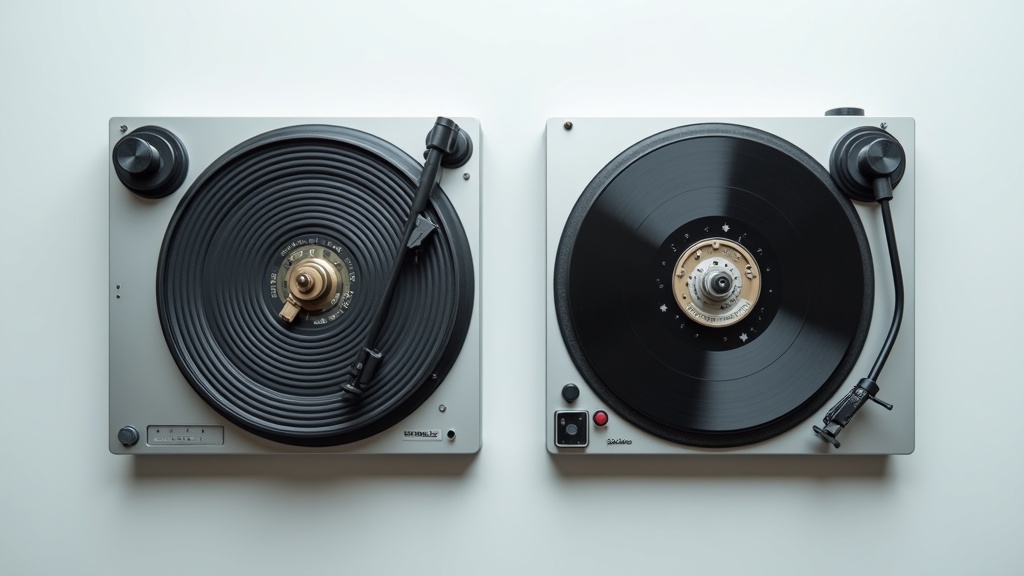
Belt Drive: The motor is connected to the platter via a rubber belt. Because the belt absorbs motor vibration, less rotational noise is transferred to the record surface. This makes belt-drive players ideal for casual listening where low noise is a priority.
Direct Drive: The motor spins the platter directly. Startup is faster and rotation is more stable, making these players popular for DJ use including scratching. They’re the go-to choice for professional setups.
There’s also the “idler drive” found in vintage machines, which uses a rubber roller as an intermediary — a classic mechanism that appeals to hardcore enthusiasts chasing a specific tactile feel. You’ll rarely find it in new production models today.
Fully Automatic vs. Semi-Automatic vs. Manual: Which Is Right for You?
This classification comes down to the classic tradeoff between sound quality and convenience.
- Fully Automatic: Press a button and the tonearm moves into position automatically, returning on its own when the record ends. There’s little risk of accidentally damaging the stylus, making this the best choice for beginners.
- Semi-Automatic: You lower the needle manually, but the arm lifts automatically at the end of the record. A good middle ground between convenience and hands-on engagement.
- Manual: Everything is done by hand. The simpler mechanism is often considered an advantage for sound quality, but if you forget to lift the arm after the record ends, stylus wear will add up fast.
💡 Quick Tip: If you’re the type to fall asleep while listening, a fully automatic player is the only way to go. Replacing a cartridge can run anywhere from a few dollars to well over a hundred, so automatic arm lift is a genuinely practical feature worth having.
MM vs. MC Cartridges: A Beginner-Friendly Breakdown
A cartridge is the pickup component where the stylus (needle) converts groove vibrations into an electrical signal. There are two main types:
| MM (Moving Magnet) | MC (Moving Coil) | |
|---|---|---|
| Output Voltage | Relatively high | Low (requires step-up) |
| Stylus Replacement | User-replaceable | Typically sent back to manufacturer |
| Price Range | Entry to mid-range | Mid-range to high-end |
| Best For | Beginners, value-focused listeners | Advanced users chasing ultimate sound quality |
MM cartridges work with a standard phono preamp (many amplifiers have one built in), while MC cartridges produce a much lower output signal and require a dedicated step-up transformer or MC-compatible phono stage. Starting out with an MC cartridge often leads to a more complex and costly system setup — something to be aware of when choosing your first turntable.
How to Choose a Record Player: 5 Key Points to Avoid Regret
As covered in the previous section, record players come with a wide range of drive mechanisms, automation levels, and other variables. Once you’ve got the terminology down, the next challenge is figuring out what actually works for you. Here are five checkpoints you should go through before making a purchase.
Budget Ranges and What Sound Quality to Expect
Record player pricing generally falls into three tiers. The experience you get at each level varies significantly, so setting a realistic budget upfront makes a big difference in how satisfied you’ll be.
- Under $300: Most models in this range feature built-in phono preamps and fully automatic operation — great if you just want a simple, no-fuss way to start listening to records. Sound quality takes a back seat to ease of use.
- $300–$800: The sweet spot balancing sound quality and usability. More models here offer switchable phono outputs, making it easier to upgrade your setup down the road.
- $800 and up: Built for serious listeners who plan to swap out cartridges and tonearms over time. Ideal for those who prioritize audio performance and intend to use the same deck for years.
The impulse to “just try something cheap first” is completely understandable, but models well under $100 often have poor cartridge tolerances and light platters that can actually damage your records. If you’re planning to stick with the hobby, treat the $200 range as your practical floor.
Built-In vs. External Phono Preamp: How to Decide
A phono preamp (or phono stage) amplifies and equalizes the tiny signal from your cartridge so it can be fed into a standard line-level input on an amplifier or powered speaker. Without one, you simply won’t get usable volume.
A built-in phono preamp means you can connect the turntable to your amp or speakers with a single cable — great if you want to keep your setup minimal. The downside is that cost constraints limit the performance of built-in circuits, and once you start caring about sound quality, you’ll likely want to switch to a dedicated external unit.
How to decide: If you want to do a serious comparison between records and streaming or CDs, plan for an external phono preamp from the start. If your goal is simply to enjoy records without overthinking it, a built-in preamp is perfectly fine. Just remember to factor in the combined cost of the turntable and phono stage when budgeting separately.
Do You Actually Need Bluetooth or USB Output?
Modern record players increasingly come with Bluetooth transmitters and USB recording outputs. These features are convenient, but they come with real tradeoffs.
- Bluetooth Output: Makes it easy to pair with wireless earbuds or Bluetooth speakers, eliminating cable clutter. However, the digital conversion and compression involved does degrade audio quality, so it’s not ideal if sound fidelity is your top priority.
- USB Output: Useful if you want to rip your records and archive them digitally. If that’s something you actively want to do, it’s a worthwhile feature to look for.
If you’re serious about sound quality, a stripped-down model without these extras may actually deliver better core performance at the same price point. More features don’t always mean better audio — keep that in mind.
Placement and Vibration Control: What You Need to Know
Record players are extremely sensitive to vibration. Place one incorrectly and you’ll get feedback (howling noise) as the speakers’ sound waves travel back through the platter. This is especially common when the turntable shares a shelf with tall floorstanding speakers or a large subwoofer.
Basic vibration control: Keep the turntable on a separate stand from your speakers, place isolating feet (insulators) underneath it, and ideally use a wall-mounted or decoupled rack. Foam and natural stone insulators are both affordable and effective starting points.
For placement, remember that you need clearance not just for the player’s body, but for the full swing arc of the tonearm as well. Before buying, check the actual effective footprint including the arm — not just the unit’s listed dimensions.
Top 10 Recommended Record Players: Side-by-Side Comparison
How to Read the Comparison Chart and What Specs Matter
A common frustration is staring at a spec sheet without knowing what to focus on. Using the five selection criteria from the previous section as a guide, this comparison chart includes only the columns that directly affect your buying decision.
4 Columns to Focus On in the Comparison Chart
- Drive Type…Belt drive (quieter) or direct drive (more durable, DJ-friendly)
- Auto Function…Fully automatic / semi-automatic / manual. Beginners will appreciate fully automatic.
- Built-In Phono EQ…”Yes” means you can plug straight into an amp. “No” means you’ll need a separate phono preamp.
- Bluetooth…Whether you can stream wirelessly to existing speakers
Because real-world prices fluctuate with exchange rates and stock availability, this chart uses three tiers instead of fixed prices: Entry (under ~$300), Mid-Range (~$400–$800), and High-End ($800+). Always check current pricing at each retailer before purchasing.
Note: Some models in this list include a cartridge, while others are sold body-only. If the cartridge is sold separately, budget an additional $30–$150 on top of the deck price — don’t overlook this when comparing total costs.
Best Record Players for Beginners and Budget-Conscious Buyers
Ever thought about getting into vinyl but had no idea where to start? Between the technical jargon and needing separate equipment like amplifiers, it can feel like a high barrier to entry. Here are three models that take the guesswork out of it. All of them include a built-in phono equalizer (the signal correction circuit required for vinyl playback), so you can plug them directly into your existing speakers or amp without any extra gear.
Audio-Technica AT-LP60X | The Perfect First Turntable — Fully Automatic Operation
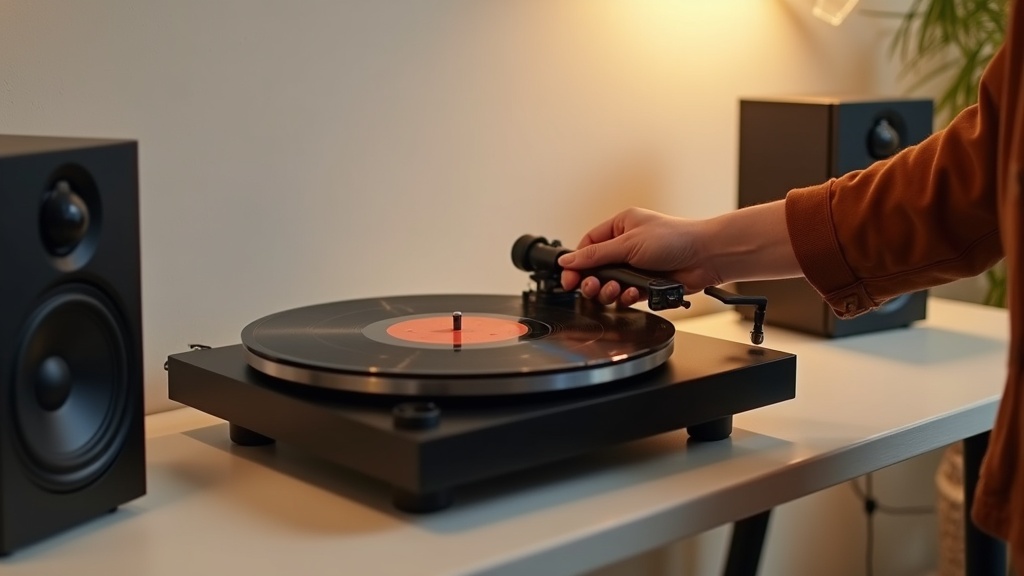
This fully automatic turntable handles everything for you — lowering and raising the tonearm automatically. When the record ends, the arm returns on its own, so there’s no risk of accidentally damaging your stylus. It’s a worry-free choice for anyone just getting started.
What we love about the AT-LP60X
- Belt-drive design minimizes motor noise interference
- Built-in phono equalizer — no separate amp required, just plug in and play
- Stylus replacement is as simple as snapping in a new needle
Things to keep in mind
- Cartridge upgrades are not supported — you can only replace the stylus
- Fine-tuning options like anti-skating adjustment are not available
Once you start chasing better sound quality, you’ll likely want to upgrade eventually — but if you just want to enjoy the magic of vinyl, this delivers more than enough for that purpose.
Check the product page for current pricing and availability.
Sony PS-LX310BT | Bluetooth Connectivity for a Modern Listening Experience
This model connects directly to Bluetooth speakers or wireless headphones. It’s a natural fit if running cables isn’t practical in your space, or if you already own Bluetooth-enabled audio gear.
What we love about the PS-LX310BT
- Supports both wired and Bluetooth output — switch between them depending on your setup
- Fully automatic operation keeps things simple, with a built-in phono equalizer
- Sony’s build quality and reliable customer support
Things to keep in mind
- Bluetooth transmission involves some audio quality trade-off compared to wired output
- For the best sound quality, a wired connection is recommended
If convenience is your top priority and you just want to dive into vinyl without fuss, this is a highly practical pick. Check the official website for full specs and current pricing.
If you’re looking for a turntable that combines wireless convenience — like pairing with your smartphone — with fully automatic operation, be sure to check out the Sony PS-LX310BT’s pricing and full specifications.
Denon DP-300F | Reliability and Ease of Use from a Trusted Audio Brand
Denon has a long history in the audio industry, and the DP-300F reflects that heritage. It offers fully automatic operation and a built-in phono equalizer, while also including basic setup features like tonearm height adjustment — giving you a little more room to grow beyond entry-level use.
What we love about the DP-300F
- VTA (vertical tracking angle) adjustment makes it compatible with cartridge upgrades
- Excellent customer support backed by Denon’s established service network
- Clean, understated design that fits naturally into any room
Things to keep in mind
- Tends to be priced higher than the two models above
- No Bluetooth — wired connection is required
If you’re thinking ahead about swapping cartridges and dialing in your sound, this model gives you the flexibility to do that. Check current pricing at retailers or the official website.
With fully automatic operation that protects your stylus and approachable setup for first-time vinyl listeners, the Denon DP-300F is a solid choice. Check the latest pricing and full specs on the official page or at your preferred retailer.
Best Record Players for Intermediate Listeners Who Prioritize Sound Quality
After spending some time with an entry-level turntable, have you ever found yourself wanting a more detailed, higher-resolution sound? Mid-range players open up a whole new world of enjoyment — from swapping cartridges to fine-tuning anti-skating adjustments. Here are four models worth upgrading to when you’re ready to take your listening experience to the next level.
Audio-Technica AT-LP120XUSB | Direct-Drive Turntable That Doubles as a DJ Deck
The AT-LP120XUSB uses a direct-drive mechanism where the motor spins the platter directly, delivering strong torque and fast startup speed. It supports pitch control and reverse playback, making it suitable for DJing and music production. With USB output built in, you can also record directly to your PC.
Who This Is For
- Those who want to use one turntable for both DJing and casual listening
- Listeners who prefer the punchy, powerful bass characteristic of direct-drive
- Anyone looking to digitize their vinyl collection via USB recording
Heads Up: Motor vibration transfers more easily than with belt-drive designs, which can be a drawback if dead-silent backgrounds are your top priority for pure audiophile listening.
If you want a turntable that handles serious DJ features and USB recording without compromise, check out the latest pricing and full specs for the AT-LP120XUSB.
Pro-Ject Debut Carbon EVO | High-Resolution Sound with a Carbon Fiber Tonearm
The Debut Carbon EVO from Austrian manufacturer Pro-Ject is a belt-drive turntable featuring a carbon fiber tonearm. The carbon arm is both lightweight and rigid, minimizing unwanted resonance and faithfully transmitting every movement of the cartridge. It comes with an Ortofon cartridge pre-installed, and there’s a wide range of upgrade options available.
Pro-Ject Debut Carbon EVO — Key Features
- Carbon fiber tonearm minimizes resonance
- Quiet, low-noise background thanks to belt-drive design
- Wide selection of compatible cartridge upgrades
Note that it does not have a built-in phono preamp, so if your amplifier lacks a phono input, you’ll need to add a separate phono stage. Make sure to check your system setup before buying.
This model comes with a genuine MM (moving magnet) cartridge right out of the box and typically retails in the $500–$700 range — impressive value for the sound quality on offer. If you want serious audio performance without breaking the bank, be sure to check the latest pricing.
Rega Planar 1 | The Classic British Belt-Drive Entry-Level Turntable
Made in the UK, the Rega Planar 1 is a belt-drive turntable equipped with Rega’s proprietary RB110 tonearm. The plinth uses a lightweight yet rigid phenolic resin platter designed to suppress unwanted vibration — a philosophy that runs throughout the entire design. Factory setup tolerances are tight, so you can expect excellent sound quality right out of the box.
Heads Up: The Planar 1 does not include USB output or a built-in phono preamp. It’s purpose-built for pure analog playback, so if you need digital recording capabilities, you’ll want to look at other options.
If you’re curious about pricing and availability for the Rega Planar 1, head over to the product page for details. Despite its straightforward design, this turntable reflects a genuine commitment to sound quality at every turn.
TEAC TN-300 | Digitize Your Vinyl Collection with USB Recording
The TEAC TN-300 combines a belt-drive mechanism with built-in USB recording capability. Thanks to the onboard phono preamp and USB output, you can record directly to a PC or Mac without any additional equipment. It’s the straightforward solution for anyone wanting to digitize a record collection that’s been sitting in storage.
The TN-300 Is a Great Fit If You:
- Want to digitize records stored at home or in the attic
- Prefer a built-in phono preamp to keep your setup simple
- Want the quiet background of belt-drive combined with digital output
Rather than chasing ultimate audio purity, this model is aimed at users who value a balance of convenience and value. Check the manufacturer’s site for full specs and current pricing.
The TEAC TN-300’s built-in phono preamp means you can plug it straight into a stereo or powered speakers — no extra gear required. Check the latest pricing and specs on the product page.
Record Players for Advanced Listeners and Audiophiles
When mid-range gear starts to feel limiting, this is the class worth looking at. If you already know the joy of dialing in your sound through cartridge swaps and fine adjustments, these models offer uncompromising precision and expandability.
Technics SL-1200MK7 | The Legendary DJ Turntable Reborn for the Modern Era
This is the current model in the SL-1200 series, which has earned a devoted following for over half a century since the 1970s. Its coreless direct-drive motor (brushless DC) keeps wow and flutter to an absolute minimum, delivering rock-solid speed stability that remains its greatest strength.
Who This Model Is Best For
- DJs and club music fans who need pitch adjustment (±8%, ±16%)
- Anyone who prioritizes long-term durability above all else
- Those who value domestic manufacturer support and service
Note: The included cartridge performs at a level typical for the price range, so budget for an aftermarket cartridge upgrade if you want to hear what this table is truly capable of. Also keep in mind that the unit is quite heavy, so placement requires some planning.
If you want a turntable that combines the reliability proven through decades of DJ use with sound quality that holds up in a home listening setup, check the latest pricing and full specs for yourself.
Fluance RT85 | High-Rigidity Build with Exceptional Value
This is the flagship model from Canadian brand Fluance, featuring an acrylic platter and an isolated motor design engineered to block vibration. Compared to competitors in the same price range, it strikes an impressive balance between rigidity and low noise, and has earned a reputation as a solid entry point into high-fidelity audio.
Key Features
- Acrylic platter reduces unwanted resonance
- Acoustically isolated motor design keeps drive system noise out of the signal path
- Some configurations come bundled with an Ortofon cartridge
One drawback is that official support options can be limited outside of North America. Before purchasing, it’s worth checking what after-sales service the retailer offers.
If you’re curious about the latest pricing and full specs for the Fluance RT85, head over to the product page — there are plenty of reviews there too, so you can get a real sense of how it performs in everyday use.
U-Turn Audio Orbit Special | American-Made with Exceptional Customizability
This is the top model in the Orbit series, manufactured in Massachusetts. It pairs a belt-drive mechanism with an acrylic platter, and its standout appeal lies in a design philosophy that lets you swap out the cartridge, tonearm base, phono preamp, and more down the line — a level of flexibility you won’t find anywhere else at this price.
Customization Example: Adding the optional Cuing Upgrade gives you a cueing lever (the mechanism that lowers the needle gently onto the record) as an add-on. This turntable is designed for a build-up approach — start minimal and add upgrades at your own pace.
One thing to note: there’s no built-in phono preamp, so you’ll need either a separate phono stage or an amplifier with a Phono input. If you want a simple plug-and-play setup, make sure your existing equipment is compatible before buying.
If you want to experience the fun of serious cartridge rolling without breaking the bank, check out the latest pricing and specs for the U-Turn Audio Orbit Special.
How to Set Up Your Record Player
It’s surprisingly common for people to buy a turntable, open the box, and then get stuck wondering how to connect everything. Here’s a step-by-step breakdown covering everything from setup to maintenance and storage.
What You Need: Amp, Phono Preamp, and Speakers
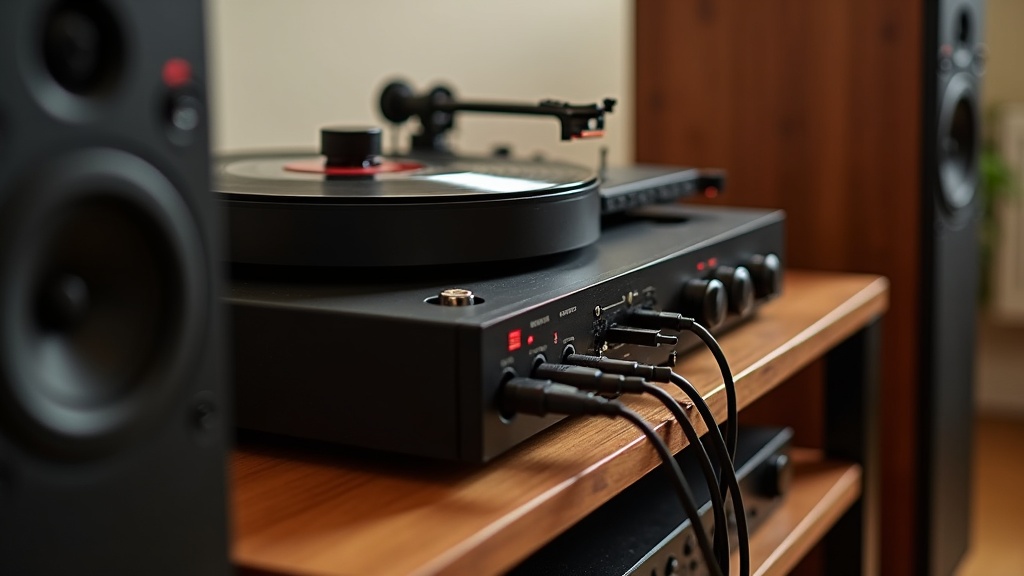
A record player can’t produce sound on its own. The signal picked up by the cartridge (stylus) is extremely weak, so it must pass through a circuit called a phono equalizer (phono preamp) that boosts and corrects the signal before it reaches your speakers.
Basic Signal Chain
Record Player → Phono Preamp → Integrated Amplifier → Speakers
※ If your turntable has a “PHONO OUT” label, a phono preamp is already built in. If your amp has a “PHONO IN” input, you can connect directly to that as well.
For a beginner all-in-one setup, pairing your turntable with a Bluetooth speaker that has a built-in phono preamp keeps the wiring simple and minimizes the chance of mistakes. If sound quality is your priority, a standalone phono preamp combined with powered speakers offers the best bang for your buck.
Basic Tonearm Adjustments: Anti-Skate and Tracking Force
Skipping these adjustments can cause the stylus to make uneven contact with the groove, resulting in distorted audio or even damage to your records. The process is simpler than it sounds.
Dial in the value recommended by your cartridge manufacturer. For even more precision, use a stylus force gauge.
Anti-skate is a mechanism that counteracts the inward pull (skating force) on the tonearm. As a starting point, set it to the same value as your tracking force.
Use the included alignment gauge to verify the cartridge mounting position. Misalignment increases distortion, so don’t skip this step.
Proper Record Storage and Cleaning
The four enemies of vinyl are static electricity, dust, mold, and direct sunlight. Avoiding these four things alone will keep your records in great condition for years to come.
- Storage: Always store records vertically. Stacking them horizontally causes warping. For inner sleeves, polyethylene is recommended over paper because it generates less static.
- Routine Cleaning: Before each play, use a carbon fiber brush to sweep dust from the grooves. The trick is to lightly brush in the direction the record rotates, as seen from the stylus’s perspective.
- Wet Cleaning: For used records or those in poor condition, wet cleaning with a record cleaning solution and a dedicated cloth is highly effective. Be sure to mask the label area — getting it wet can cause it to peel.
Don’t Forget to Clean Your Stylus Too
Debris buildup on the stylus tip can damage your record grooves over time. Make it a habit to clean the stylus with a dedicated stylus cleaner every few records.
Final Recommendations by Use Case
Now that you know how to set everything up, it’s time to make your final decision on which model to buy. Once you’re clear on your use case, the right choice becomes much easier to identify.
Best Models by Use Case: A Final Summary
Here’s a breakdown of the best direction to take depending on your needs. For specific model names, check the latest stock and pricing on official websites or at your local retailer.
【Beginners / Just Want to Get Started】
Look for an all-in-one model with a built-in phono preamp that connects directly to speakers. The biggest advantage is minimal setup — you can have music playing the same day you buy it. The ceiling for audio quality is lower, but it’s more than enough if your goal is simply to start listening.
【Serious About Sound Quality】
Go for a separate-component belt-drive turntable that supports cartridge swapping. It requires a separate phono preamp and amplifier, but this setup allows for meaningful upgrades down the line.
【DJ / Scratching】
Direct-drive is the only way to go. Strong torque and reverse playback support are non-negotiable. Even if you plan to use it for casual listening as well, starting with a direct-drive model gives you the most flexibility.
Pre-Purchase Checklist
Running through these items before you commit to a model will save you from buyer’s remorse later.
Does your existing amp have a phono input? (If not, you’ll need a turntable with a built-in phono preamp or a separate external one)
Have you measured the actual installation space — depth and width? (Turntables often take up more physical space than the catalog dimensions suggest)
Is a replacement stylus readily available for the model you’re considering? (For lesser-known models, finding replacement parts can be a serious problem)
Does your budget include the cost of a cartridge, stylus, and cleaning supplies?
If you compare models by body price alone, you can easily get hit with unexpected costs for accessories afterward. A smarter approach is to set your total budget first, then work backward to determine your ceiling for the turntable itself. Be sure to check the latest specs and pricing for each model on the manufacturer’s official website.